
Reflection piece on the importance of language
Language is one of the most common and “simplest” means of discrimination, whether intentional or not. A racist insult, an ableist label or even a term that excludes a particular group can be uttered in an instant, yet it may deeply affect people in that moment and have lasting consequences. It can, for example, discourage someone from taking part in everyday community life in all its dimensions (sport being one of the most significant).
We often underestimate the power of language and therefore use it lightly. This applies not only to individuals but also to civil society and sports organisations. Language plays a crucial role in helping people feel that they belong and can participate fully. It operates on different levels: an immediate one, forming first impressions and being a first determining factor, and a longer-term one, shaping how an organisation is perceived (who it represents, and in what way).
As emerged across the various activities of the ChangeMakers project (from the Survey to the Training), there are many barriers that play a significant role in shaping how people access and engage with grassroots sport. Language is no exception.
The language we use every day has been one of the most recurrent discussed issues within the ChangeMakers partnership. We have reflected extensively on the terminology used in anti-discrimination work, recognising how words can take on different nuances (and therefore different social connotations) across the national contexts we represent. More importantly, we have reflected on how terms often perceived as neutral can, in fact, carry embedded power dynamics that reinforce specific stereotypes and discriminatory behaviours.
In an effort to dig deeper on this, and in a bid to share at least a common vocabulary, we have developed a Critical Glossary to start questioning some of these words. Rather than presenting a list of “bad” words or claiming universal representativeness, the glossary is intended as a dialogical tool to encourage critical thinking about language. It does so while recognising that no word exists in a vacuum; each is spoken or written within a specific and constantly evolving socio-economic context.
Words can both foster and shape narratives. Take, for example, the term “minority.” It is often used to refer to:
“A group that is characterised by its relative powerlessness compared to a dominant majority group, which often holds social, economic, and political power. Despite the term can refer to groups usually numerically smaller than the majority population of a State or region, in this context minority status does not necessarily correlate to demography, but more on power distribution.”
(Britannica, Vickerman, Milton D., 2024, EMN)
As the definition itself suggests (and as we highlight in the Glossary), the use of this term can reinforce existing power dynamics rather than challenge them, as it reflects the perspective of the socially dominant group. It can also contribute to processes of victimisation and stigmatisation, framing certain groups within a persistent narrative, instead of recognising them simply as individuals with agency in society.
Reflecting on the perspectives embedded in the words we use is a crucial first step toward building a society in which everyone can participate on equal terms. In the Glossary, we seek to unpack terms such as “diversity,” “inclusion,” and “integration” through a decolonial lens.
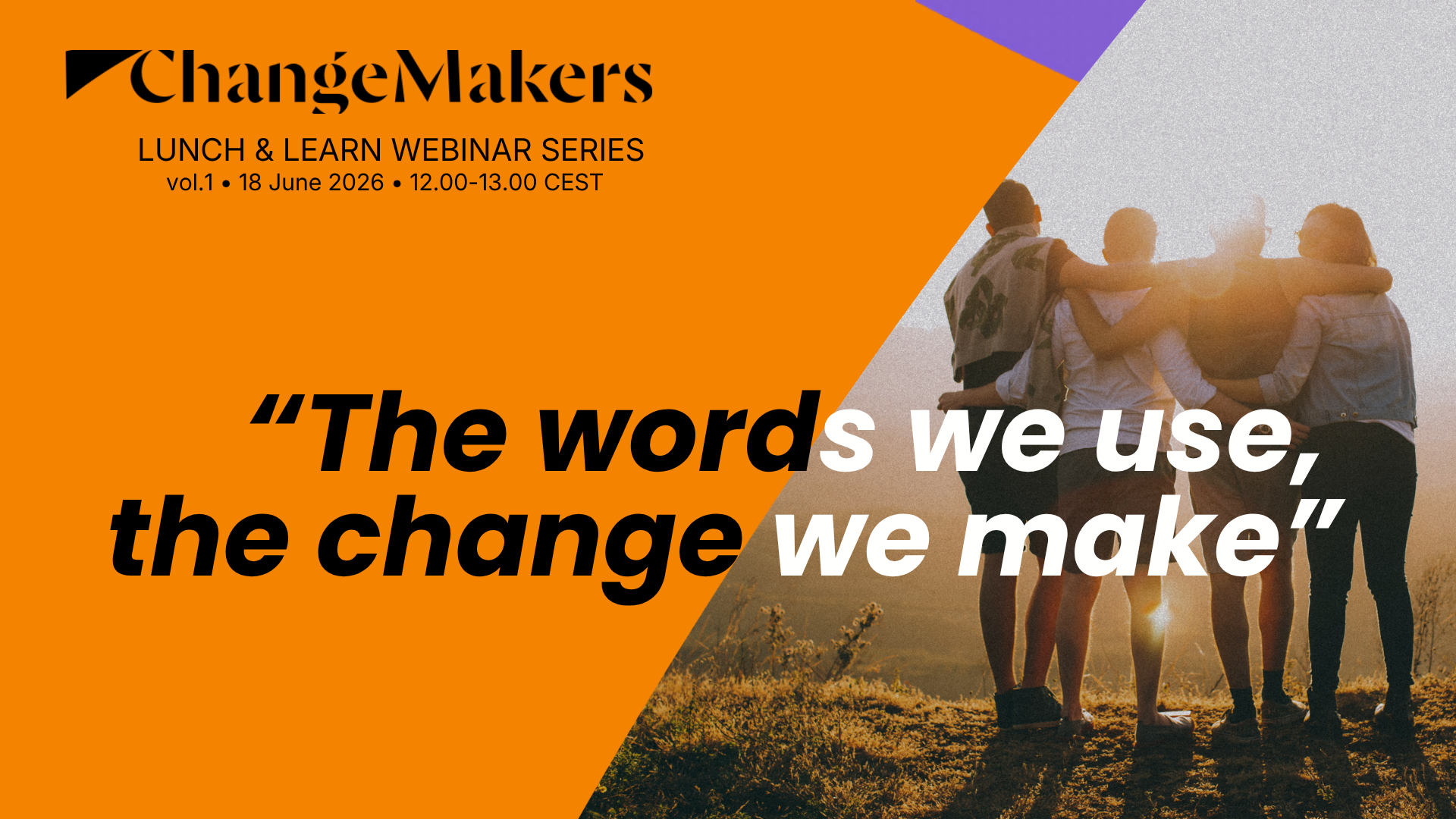
We aim to continue supporting this process of critical reflection on language. While we may not have definitive answers, we are committed to questioning and challenging the words we use, even when it feels uncomfortable, in order to foster meaningful change. To this end, on 18 June 2026, we brought this conversation to our first ChangeMakers Lunch and Learn: The Words We Use, the Change We Make.
Over the course of an hour, participants from across Europe explored these questions together. The session opened with a keynote from Lunaria on the socio-political dimensions of language in anti-discrimination work, followed by testimonies from two ChangeMakers. Hassan Hosseini (DTB, Germany) shared how he had been consistently referred to as “the black hat” at training sessions rather than by his name. Mona Abdullah (NIF, Norway) reflected on her own experience navigating language and belonging in sport. The session closed with a collective exercise on two words routinely used in our field (“victim” and “inclusion”), inviting participants to question their own vocabulary in real time.
The replay is now available here. We encourage you to watch it if you missed the session or would like to revisit the conversation.
The Critical Glossary was built over the course of the project as a shared working tool within the ChangeMakers partnership (developed with and for the organisations involved in piloting the approach, and not intended for general distribution). It distils two years of collective reflection on the terminology used in anti-discrimination work across five national contexts. It is designed to be questioned, challenged and developed further rather than treated as a definitive reference. We are making it available to those who join the ChangeMakers Community of Practice as a first resource to work with, because we believe this kind of reflection is most meaningful when shared with people ready to engage with it.
If this conversation sparked something for you or your organisation, we invite you to register your interest in the ChangeMakers Community of Practice. Language is where we started, but it is not where the conversation ends. The Community of Practice is a space for peer exchange across borders on the broader questions this project raises: how organisations build more inclusive practices, how they engage the people they serve, and what change looks like from the inside. Registering at this stage is simply an expression of interest, with no commitment attached.
LINK TO THE CoP REGISTRATION PAGE: https://iscaorg.typeform.com/to/oM9e7uo6